
I recorded a pitch the other day. Read back as a transcript, it was good: a clean hook, a real traction number, a clear ask. The content score agreed and put it in the high 80s.
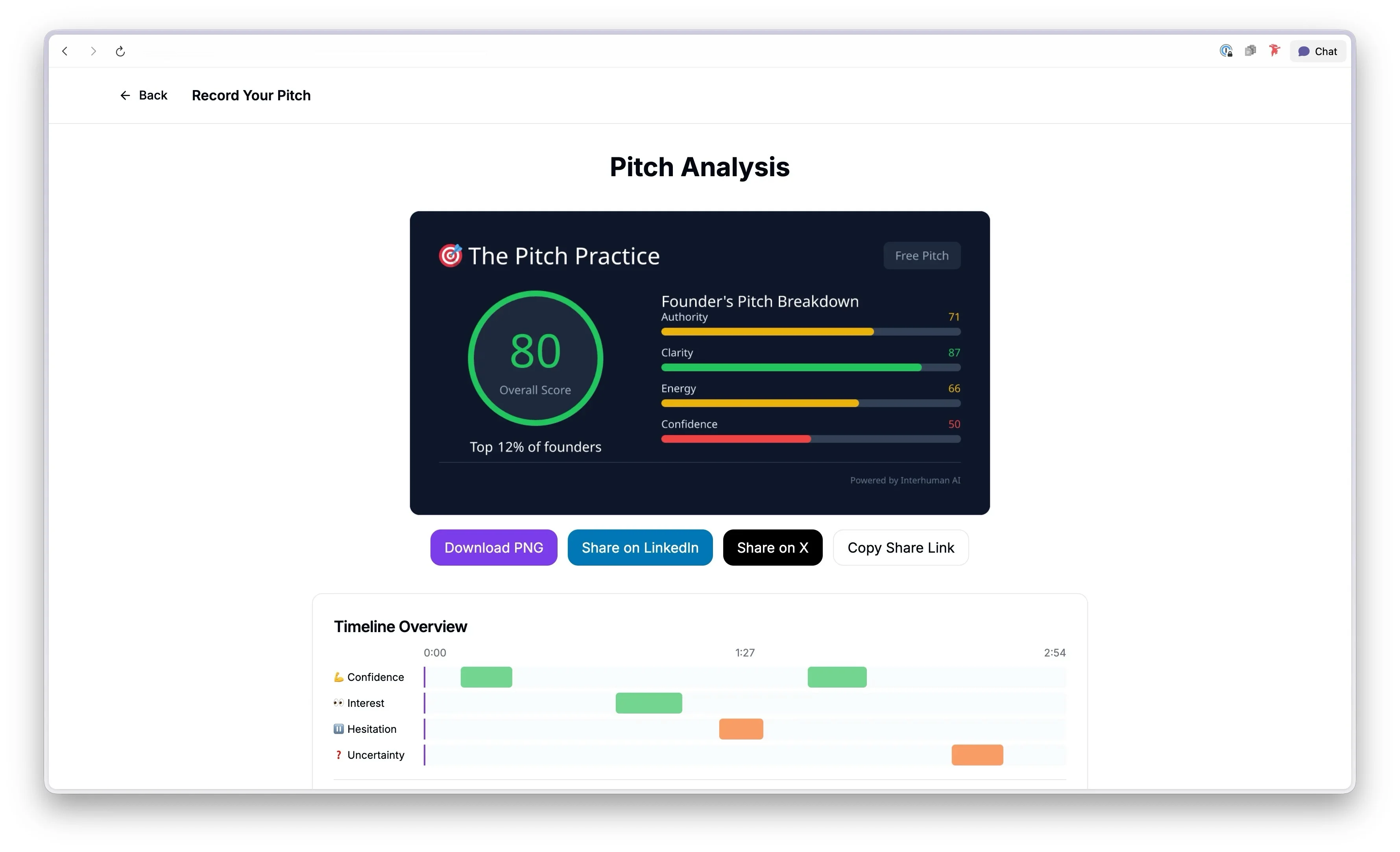
Then I watched what the demo said about how I'd actually delivered it. Clarity, fine, an 87. But energy sat at 66 and confidence at 50, because there was a pause right before the traction number and the ask trailed off at the end. Good words, shaky room. Overall: 80. That gap between the two scores is the thing this whole demo is about.
Author: Filip Sardjoski
Practice in a room that can't judge you
Practising a high-stakes pitch is miserable. You either rope in a colleague who's heard it four times already, or you talk at your own reflection and try to imagine how it's landing. Most people just don't practise, and then they wing the thing that decides whether they get funded.
The Pitch Practice is a place to rehearse where nobody's watching. You record a pitch to your webcam, and you can do it again, and again, until it's right. There's no audience to perform for, and no colleague whose patience you're spending on take number five.
Every pitch coach eventually tells you the same thing: go practise in front of the mirror. It's good advice and it has one obvious flaw, which is that the mirror never tells you anything. You can't see your own hesitation while you're busy hesitating. This is a mirror that talks back. It watches the recording and tells you where you lost the room, so you can fix it before it counts.
There are two ways in:
- Practice your pitch. A full 1 to 3 minute run, scored on your delivery and your words together.
- The 1-Minute Challenge. Sixty seconds, hard stop, with a global leaderboard if you want to put a number on it.
While you record, your video streams to Inter-1 a few seconds at a time, so the read is basically done by the time you stop talking.
The half nobody scores
Pitch coaching is mostly about the script. Tighten the hook, name the problem, put a number on the traction, close with the ask. Good advice, and all of it about words, the part you can write down and edit in a doc.
But investors don't fund the doc. They fund the person in front of them, and that read happens on a channel the transcript never captures. The same line, "we're growing 40% month over month," can sound like a fact or like a hope, and the only difference is how you say it. That's the half coaching skips, because until now it was the half nobody could measure.
So we measure it. The words run along the bottom of a timeline, and Inter-1's behavioural signals sit on top: confidence, hesitation, stress, uncertainty, interest, each one pinned to the moment it happened with a reason attached.
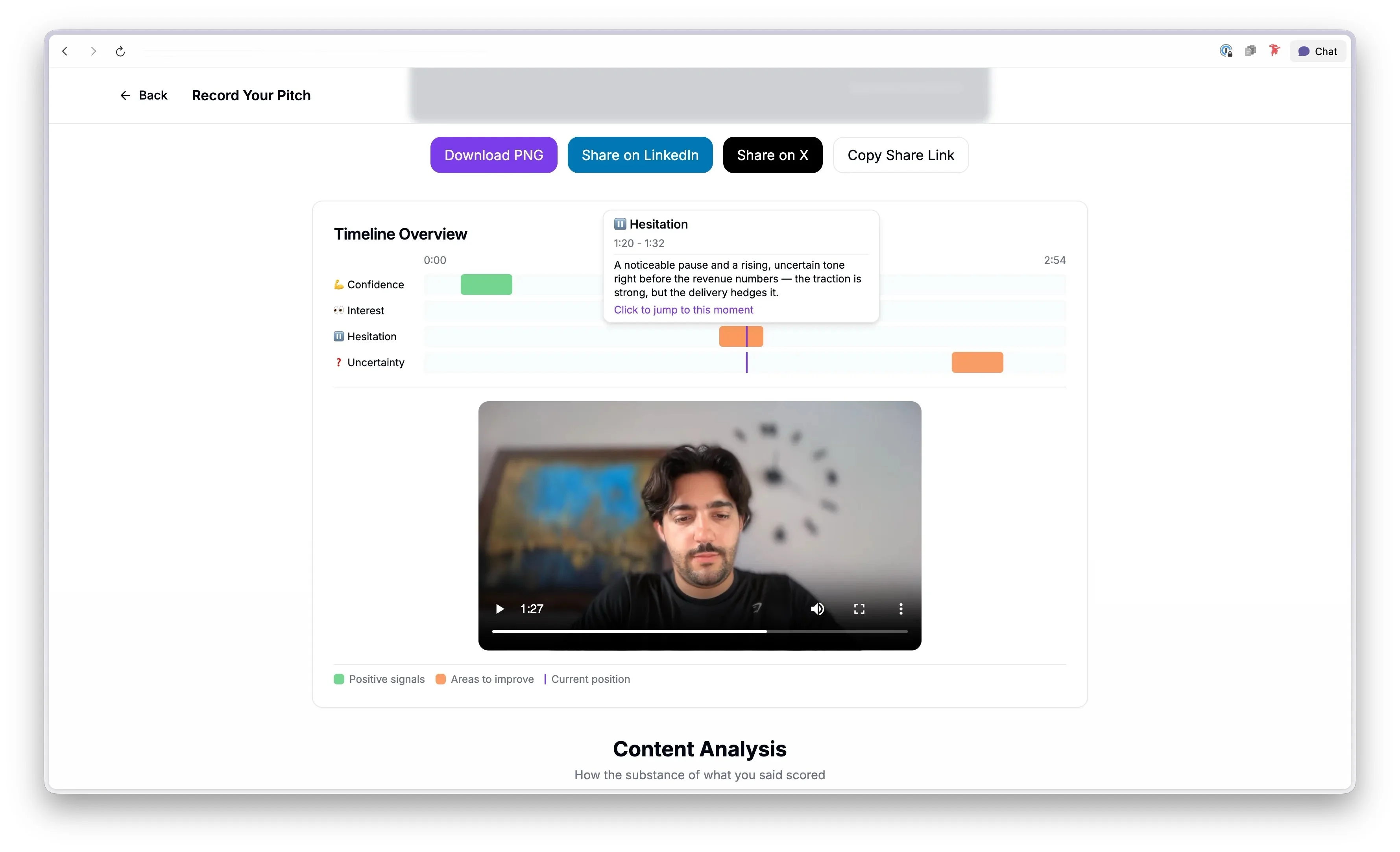
Look at my pitch again. The words scored in the high 80s and deserved it. The delivery told the rest of the story: a hesitation signal landed right on the traction figure, flagged as "a noticeable pause and a rising, uncertain tone right before the revenue numbers, the traction is strong but the delivery hedges it," and the energy drained out of the close. The feedback isn't "your pitch is an 8." It's "say the traction number like you believe it."
How the score is built
The headline number splits evenly: half delivery, half content. A flawless script read flatly and a rough script delivered with conviction both have a problem, and the even split shows you which one is yours.
Delivery comes from Inter-1, using its conversation-quality read plus the social signals across the recording:
- Authority: decisiveness and credibility (30%)
- Clarity: how easy you are to follow (25%)
- Energy: vitality and presence (20%)
- Confidence: confidence signals net of hesitation and uncertainty (15%)
- Low hesitation: a penalty when hesitation, stress, and uncertainty pile up (10%)
Content comes from the transcript, scored against a six-part rubric (message clarity, problem framing, solution and value, evidence and specificity, narrative, and the ask) plus two mechanical checks: pace, where about 150 words a minute reads best, and filler density, which counts every "um" and "you know."
What's under the hood
If you build things, this is the part for you. The behavioural half of that score is Inter-1 Streaming, and the integration is small enough to read in a sitting.
The browser records in short chunks and pushes each one down a WebSocket as it's captured. Inter-1 sends back a typed event stream, which the client folds into the timeline you see on the results page:
const ws = new WebSocket("wss://api.interhuman.ai/v1/stream", [token]);

ws.onmessage = (e) => {
  const event = JSON.parse(e.data);
  switch (event.type) {
    case "signal.detected":   // { signal, probability, rationale, t }
      addSignal(event); break;
    case "conversation_quality.updated":  // clarity / authority / energy
      updateScores(event.scores); break;
  }
};
Nothing waits for an upload to finish. Signals arrive while you're still talking, which is what makes the live timeline possible.
The whole demo is open source: github.com/InterhumanAI/interhuman-example-pitch. Clone it, read the streaming client, and lift the behavioural layer into whatever you're building, whether that's coaching, interviewing, or sales practice. If you want the protocol in full, the Streaming announcement walks through it and the docs have the rest.
Think you can out-pitch us?
The team here practises on this thing too, and our scores are on the leaderboard. Take the 1-Minute Challenge, post a number, and see if you can beat us. Worst case you get a few reps in before the next pitch that actually matters.
A transcript scorer was never going to tell you why a clean pitch fell flat, because the reason isn't in the transcript. It's in how you carried it, and that's the half that gets you the cheque. Now you can practise it somewhere safe, watch it scored, and run it again until the room goes your way.
Record a pitch and see your own delivery scored. It takes about a minute.